
The Viral Fear - And Hope - Of Digital Freight Exchanges
A big discussion sparked by Aleks Levko's LinkedIn post about DAT competing with brokers went viral this week. It set off alarms for many people! Aleks captured the real fear, and tension, that's present in the freight industry about the new digital freight exchanges (or "freight marketplaces") that are currently gaining traction. It's clear that people are fearful that large freight-data and marketplace platforms may no longer be neutral infrastructure providers, but rather active participants in the transactional flow of freight itself. They're not. People fear they'll be replaced. They won't be (for the most part). Let me tell you why.

[Written 100% by Tim Higham, and not AI. Although, I did have AI check my spelling and grammar, lol]
The recent discussion sparked by Aleks Levko's LinkedIn post about DAT competing with brokers using their new Convoy Platform went viral this week. It set off alarms for many people!
First, I HIGHLY recommend that you read his full post and ALL of the comments. See the above link!
The financial benefits of using DAT's Convoy Platform are unquestioned for many people, but Aleks captured the real fear, and tension, that's currently present in the freight industry about the new digital freight exchanges (or "freight marketplaces") that are currently gaining traction. It's clear that people are fearful that the large freight-data and marketplace platforms may no longer be neutral infrastructure providers, but rather active participants in the transactional flow of freight itself.
In my opinion, they're not.
Freight brokers also fear that they'll be replaced.
They won't be (for the most part, anyway).
But, in practical terms, the fear is very real.
If an established platform such as DAT (or any "load board") possesses the freight data, carrier network, rate intelligence, load-board liquidity, automation tools, and now the digital "match & move" execution layer through their own technology architecture, such as the Convoy Platform, then freight brokers are forced to ask an honest question: Is this marketplace I use becoming my competitor?
That question is not just paranoia. It’s a rational reaction. Structural change like this breeds fear, and there's an abundance of fear everywhere right now.
For decades, brokers have relied on freight load boards as utilities. They helped match loads with trucks, improved market visibility, and gave brokers access to fragmented carrier capacity. The broker and the carriers remained the commercial actors in the transaction - and the load board marketplace was simply the venue.
But digital freight exchanges can, and may, change that arrangement for everyone.
A true digital freight exchange is not merely a place where freight is posted. It's a system that can increasingly perform many of the functions historically handled by humans: identifying the capacity, validating the carrier, pricing the freight, covering the load, booking the shipment, tracking every event of the execution, managing any (simple)exceptions, and supporting final payments.
This is why this issue has gone viral. They could just connect the shipper and bypass the broker? Right?
This fearful reaction is coming from a broad realization that freight intermediation itself is being redefined. It is.
And that realization naturally creates fear. A LOT of fear.
But fear, while understandable, is not the full story.
In my opinion, and from my privileged vantage point as the CEO of the most widely used TMS software platform for freight brokers, carriers, and shippers, the conclusion should be that change is not only coming - it's already here.
Freight is moving toward digital exchanges because the economic logic is overwhelming to do so. Every industry eventually digitizes its repetitive, rules-based, information-heavy workflows. We all know that freight has been slower than many other industries to "digitize"because it is so operationally complex, relationship-driven, fragmented, exception-heavy, and dare I say it, "stubborn", lol.
But, being slow and stubborn doesn't mean immune!
The same forces that transformed banking, travel, insurance, advertising, retail, and financial markets are now reshaping freight. The reason isn't ideological. It's just capitalism.
Digital freight systems (these new exchanges) reduce friction.
• They reduce duplicated work.
• They reduce manual communication.
• They reduce fraud.
• They reduce time-to-coverage.
• They reduce compliance gaps.
• They reduce payment delays.
• They reduce uncertainty.
In a market (like freight) where margins are thin and service expectations are high, that friction is not a minor inconvenience, it's a structural cost - and thus it's an easy target.
That cost is being attacked by software. Again, it's just capitalism at work.
This doesn't mean every broker disappears. It does not mean relationships vanish. It does not mean your expertise becomes irrelevant. In fact, the opposite may be true.
As routine execution becomes automated, real expertise becomes more valuable because it can be applied where it matters most: complex freight, distressed freight, high-service customers, difficult lanes, specialized equipment, exception management, and strategic account relationships.
But it does mean that the old definition of freight brokerage is changing.
Historically, a broker could create value simply by knowing where to find a truck. In many cases, that was enough. Information asymmetry was the business model itself.
In this emerging digital freight market, the old model is no longer sufficient.
Finding a truck is becoming a simple software feature.
But solving a real freight problem - running a freight department - is still a business.
That distinction matters.
The likely end state is not a freight market with hundreds of digital freight exchanges, though. Markets with strong network effects don't usually evolve that way. They slowly emerge and then they quickly consolidate. Liquidity (money) attracts liquidity. Buyers go where sellers are. Sellers go where buyers are.
In freight there is an old saying that"carriers follow the freight". It’s true.
This is why it's my opinion that freight will likely consolidate around a small number of major digital exchanges. Perhaps 3or 4 major and trusted freight exchanges will truly matter in the end. I expectDAT's Convoy Platform to be one of them. Highway's TFX (Trusted Freight Exchange) is another. My sources also tell me that Truckstop isn't far behind, and several others are making their moves, too.
The financial prize for the winner(s) is huge.
Some of these exchanges may operate in specific niches, modes, regions, or specialized freight categories. I have no idea how that will shake out, but the broad pattern is pretty clear to me: freight liquidity will increasingly organize around a few connected, trusted, and proven digital networks.
And your Transportation Management Systems (TMS) will then become even more important to you. It will become the "on ramp" for those who want to participate and move profitable freight.
Why? Because the TMS is where you live. It is where loads are created, managed, dispatched, tracked, billed, documented, audited, and analyzed. It is where the operating of your business takes place.
In this new world, your TMS becomes the access and execution layer between the freight to be moved and the driver that moves it. The digital exchanges will do the heavy lifting.
And, no, the broker will not need to log into multiple marketplaces, manually enter the same shipment data, chase updates across disconnected systems, and reconcile documents after the fact. The TMS will connect the user seamlessly to those networks for you, normalize the workflows, protect the user, and make the entire process operationally easy.
That's my version of this future, anyway.
The exchange just provides you with the two-sided market access.
The TMS provides the execution and the workflow control for you - the participant.
The human TMS operator provides judgment, service, and commercial strategy to shippers.
That combination is not bad for the industry. It's good. Properly built, it's good for brokers, carriers, shippers, and software providers alike.
For brokers, it means the opportunity to operate with less repetitive labor and more strategic focus.
For carriers, it means access to freight with less wasted time, fewer phone calls, clearer expectations, and faster execution.
For shippers, it means better visibility, more consistent service, faster responses, and a more transparent market.
For TMS providers, it means the system of record becomes the system of action.
It also eradicates fraud for everyone.
For the overall freight ecosystem, digital "match and move" through one of these new exchanges means less friction.
The important point here is that this is not a question of whether the industry likes change. They hate it. But markets don't ask permission before changing. They change when the technology becomes capable and trusted, the economics become obvious, and the customer benefit becomes too large to ignore.
THEN, the entire herd moves en-masse. The new replaces the old.
Our industry, my friends, is entering a digital exchange era, and we cannot stop it.
The only practical question is where each participant (that's you) will fit.
If you're a broker, your task is to determine what your durable value will be when routine freight execution becomes increasingly automated. The answer may be specialization. It may be service quality. It may be vertical expertise. It may be complex freight. It may be high-touch account management. It may be exception handling. It may be trust.
But, it cannot merely be access to a load board anymore.
If you are a carrier, your task is to become easier to trust, easier to verify, easier to track, easier to pay, and easier to work with.
If you are a shipper, your task is to choose partners who can just "get the job done" for you, and trust that they (or "it") will.
If you are a TMS provider, your task is to connect these ecosystem(s), to invisibly automate the mechanical work, and to give users frictionless access to this new freight infrastructure without burying them in complexity to get started.
This is not temporary.
This is structural.
The good news for all of us, especially you reading this, is that this transition will not happen overnight. Freight is just too complex, too fragmented, too slow, and too relationship-based for that to happen.
My best guess is that it's likely going to be a 3-to-10-year transformation period, and that gives everyone time to adapt.
But you cannot ignore the story of the frog in the slowly heating pot. We are ALL in the pot as I type this, and the temperature is rising.
The chess pieces are moving.
So, yes, Aleks is right to identify the fear that we all feel. You just need to harness that fear and turn it into action.
Freight brokers, carriers, and shippers are all right to worry about what this all means. They are right to ask whether their current partners could become future competitors.
Freight is not going away. Brokers are not going away. Carriers are not going away. Shippers are not going away. Relationships are not going away. Operational judgment is not going away.
It's just being reshuffled.
The question is no longer whether digital freight exchanges are coming.
They are already here.
The question now is where you'll fit in?
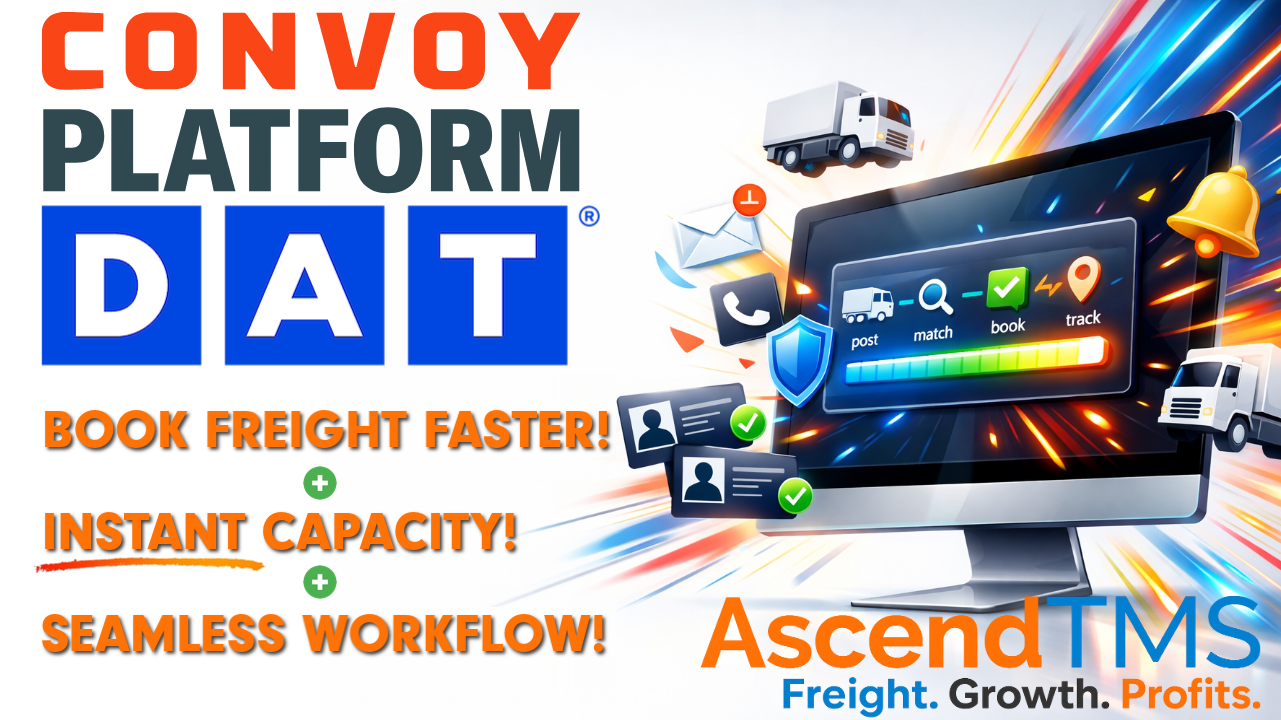
My advice? Start using one or more of these freight exchanges in whatever TMS you use (or try it totally free in AscendTMS right now and I’ll eat the cost of the first 3 loads for you).
You first need to see what these exchanges can do and what they can't. You need to see the financial results that they actually deliver. Then, make your move before the herd does.
Good luck!
Tim Higham
CEO
Check out more

No Contracts. No Setup Fees. No Credit Card Needed.
This should be the easiest decision you make today!